
Edge AI Hardware vs. Camera-Analytics SaaS – the 2025 Playbook (Expanded)

De Flow AI Team
Edge AI Hardware vs. Camera-Analytics SaaS – the 2025 Playbook (Expanded)
(Every fact below links to a non-competitor source so you can read more.)
Market Context
- Retail shrink hit $112.1 billion in 2022 – up from $93.9 billion a year earlier – per the National Retail Federation.
- Roughly 29% is employee-driven, not shoplifting, says Retail Dive.
- "Locked-behind-plexiglass" aisles are now common, notes Axios.
- The combined IP Video + VSaaS market will reach $83 billion by 2030, forecasts Allied Market Research.
- Edge-AI chipset shipments are soaring, driven by latency and sovereignty needs (Grand View Research).
Quick Definitions
| Term | What it means |
|---|---|
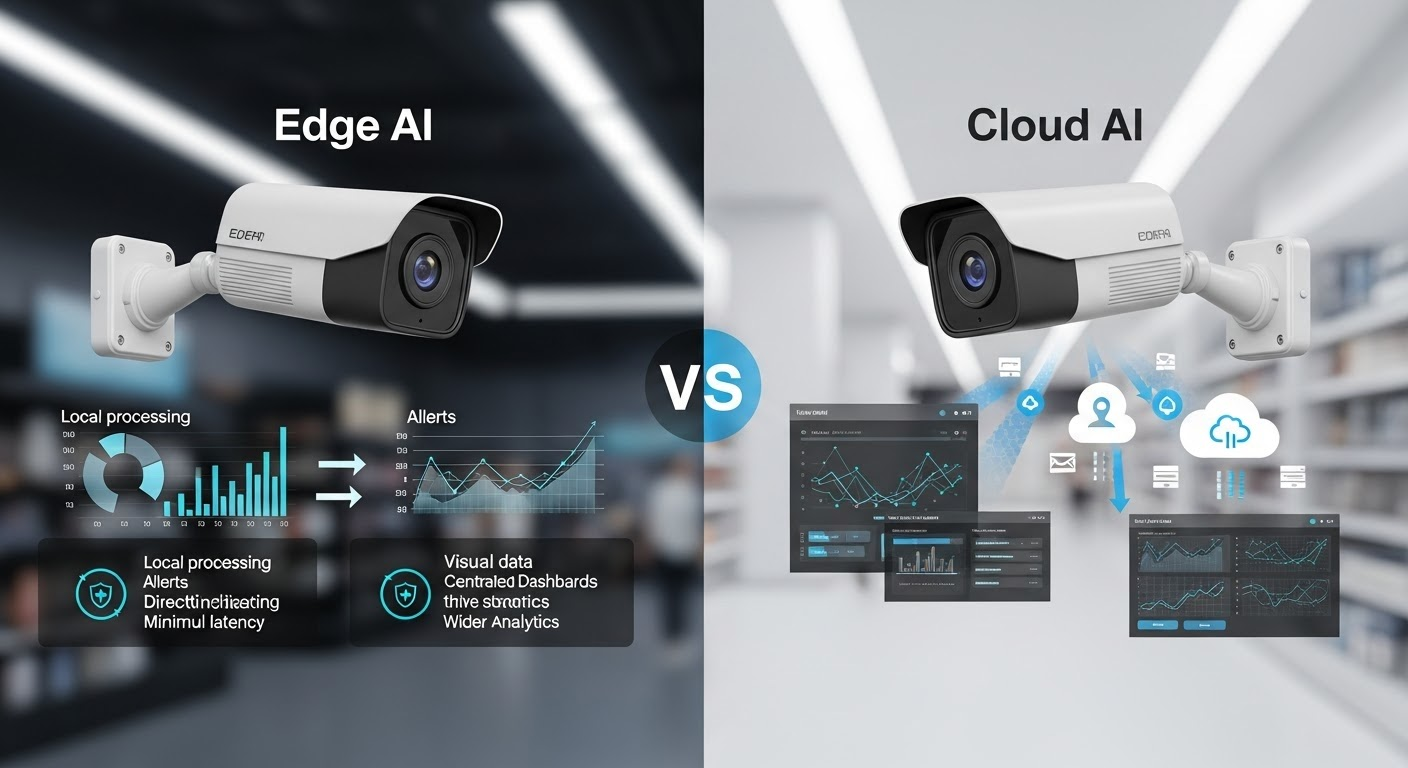
| Edge AI appliance / smart camera | Camera or on-prem box with GPU/NPU that runs CV models locally – see Axis Edge-Analytics infographic. |
| Camera-analytics SaaS (VSaaS) | Cloud platform that ingests video and processes AI off-site (e.g., Azure Video Indexer). |
Side-by-Side Comparison
| Dimension | Edge AI Hardware | SaaS (De-Flow model) |
|---|---|---|
| Latency | Milliseconds on-site – ideal for safety cut-offs. NIST explains edge latency in its SP 500-325. | Sub-second in most stores – fine for loss-prevention (LP) and merchandising alerts. |
| Bandwidth | Little to no uplink (just metadata). | Video (compressed) streamed to cloud. |
| Scalability | Buy/install hardware per store; truck-roll for upgrades. | Elastic – add cameras via API; models update centrally. |
| Up-front CAPEX | Smart cameras cost 25-50% more than IP; edge box ≈ $5-8k per site (AWS Panorama). | Near-zero CAPEX; Forrester TEI shows 60% infra savings for cloud (Microsoft study). |
| Model refresh | Flash firmware or swap hardware (months). | "One-click" roll-outs; weekly refreshes (IBM AI in Retail). |
| AI horsepower | Limited by on-device silicon. | Unlimited GPU/TPU – run heavy LLM + CV pipelines (McKinsey). |
| Data residency | Video stays on-prem – helps with strict laws. | Needs cloud compliance; ISO 27001/SOC 2 mitigate risk (Deloitte). |
| Maintenance | Local IT must patch, cool and monitor hardware. | Provider handles uptime, patches, backups. |
| Five-year TCO | 15-30% higher once hardware refresh & field service are counted (PwC fraud survey). | Predictable subscription; unlimited model revisions, no forklift upgrades. |
Extra Points You Asked For
| Topic | Edge AI | SaaS Camera Analytics |
|---|---|---|
| Initial install | New smart cams or edge box; electrical & cabinet work ⇒ high CAPEX | Plug existing RTSP/ONVIF cameras into cloud; minimal CAPEX |
| Adding new features | Requires new firmware or hardware swap | New dashboards & models appear instantly |
| Better internet every year | Benefit is marginal | 5G & fiber are making upstream bandwidth cheap → SaaS ROI improves annually (see Cisco VNI projections) |
| Offline / fail-safe | Works locally if the line drops | De-Flow keeps a 24h edge cache; runs light models offline and back-fills when the link returns |
| Number of true "plug-in" SaaS vendors | Dozens of NVR / edge makers | Few SaaS players work with any camera (De-Flow, Azure VI, Platea) – lower vendor crowd, deeper support |
Internet Is Getting Faster – Why That Matters
Cisco's VNI projects average retail uplink to top 40 Mbps by 2027, while private 5G offers 25× current in-store bandwidth. As prices for cloud storage per GB keep dropping (see AWS Economics), SaaS streaming costs decline and the edge-bandwidth advantage shrinks.
First-Install Cost Snapshot
| Item | Edge (₪) | SaaS (₪) |
|---|---|---|
| Smart cam / edge box | 5,000 – 20,000 ea. | 0 (reuse HD cameras) |
| Rack & power | 2,000 – 5,000 | 0–500 (PoE only) |
| Technician time | 1-2 days/store | ≲ ½ day (firewall + RTSP) |
| Total CAPEX | 12k – 30k ₪ | 0 – 2k ₪ |
(Cost bases: AWS Panorama, Axis, Forrester TEI.)
What Happens When the Connection Drops?
| Mode | Behaviour |
|---|---|
| Edge-only | Continues locally but loses cloud-wide insights. |
| SaaS + De-Flow Edge Cache | Stores 24h of events, runs slim models offline, syncs automatically when the link returns. |
Few SaaS Vendors → Stronger Buyer Leverage
Many VSaaS offerings require proprietary cameras. De Flow AI works with cameras that expose a standard ONVIF or RTSP stream, which is what most modern IP cameras do — though whether YOUR specific models and firmware qualify is something to confirm against your actual estate rather than assume. Where they do, that means:
- Transparent per-camera pricing
- Shared roadmap influence
- Deep ERP / POS / RFID integrations without third-party fees
Updated Bottom Line
- Edge still wins where latency < 100ms, zero connectivity, or strict sovereignty is non-negotiable.
- For mainstream retail, camera-analytics SaaS delivers faster roll-out, richer AI and lower five-year cost – and the case only gets stronger as fiber and 5G expand.
De Flow AI is purpose-built for this SaaS future: instant connection to your existing cameras, weekly model refreshes, edge cache for outages, and a live ROI dashboard.
Want to see how painless the switch can be?
Book a 15-minute demo and discover how SaaS can slash CAPEX by ≈ 90% versus traditional edge hardware.
Sources 2023-2025: NRF, Retail Dive, Axios, Allied Market Research, Grand View Research, Axis, AWS, Forrester, Cisco VNI, MIT Sloan, Deloitte, IBM, McKinsey, PwC.
Want to see how this works in your stores?
Tell us about your business and we’ll come back with a practical plan — no commitment.